
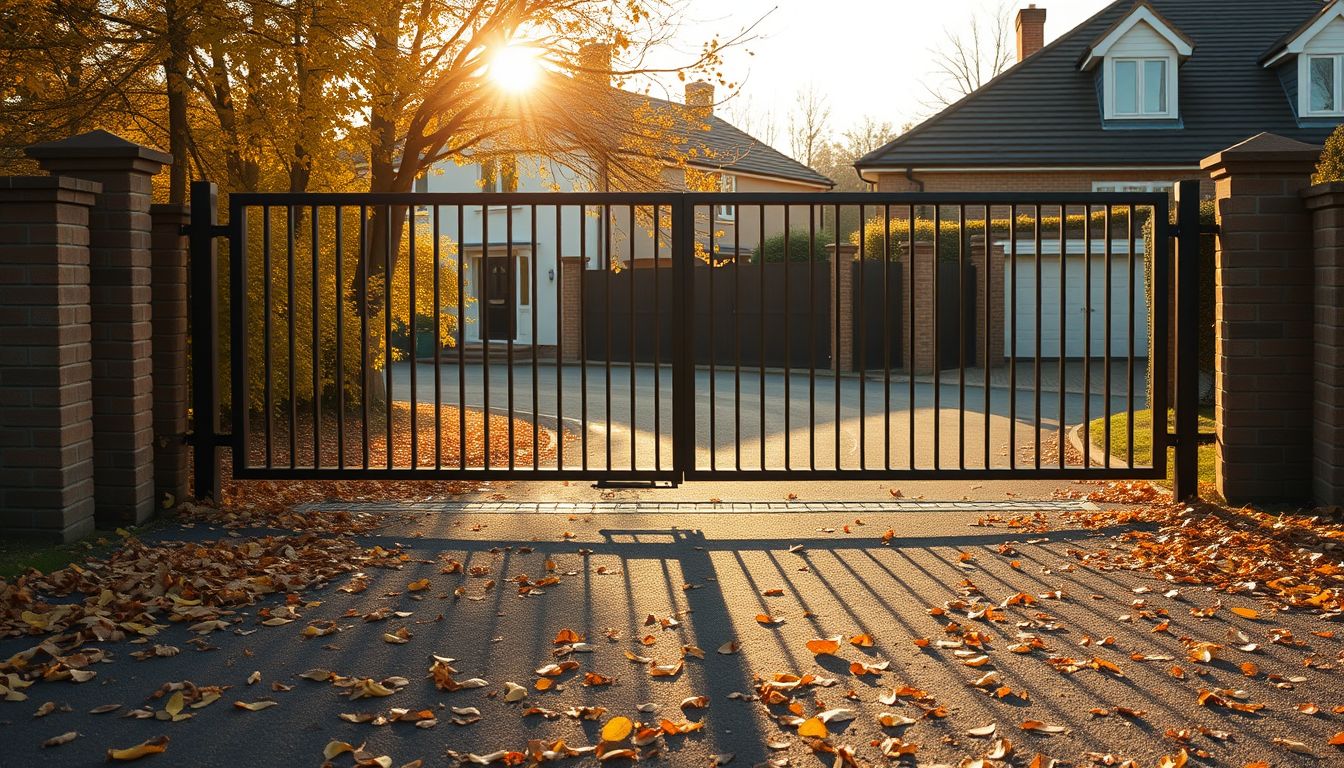
The clocks go back at 2am on Sunday 25 October, and from then on many of us will be using our gates in the dark at one or both ends of the day. Add falling leaves, damp mornings and the first frosts, and autumn is the time of year when small niggles with automatic gates tend to show up.
Whether you have a driveway gate at home or a busy entrance at a commercial site, half an hour of simple checks now can save a frustrating morning later. If anything looks wrong, leave the fix to a qualified engineer.
1. Clear leaves and debris from the gate’s path
Leaves pile up quickly against gate posts, in sliding gate tracks and around ground-level equipment. Wet leaves and mud can stop a gate moving smoothly. Sweep the area the gate travels through, and clear around the base of posts and any ground-mounted sensors.
Make sure nobody operates the gate while you’re working near it.
2. Keep your photocells clean and clear
Photocells are the small safety sensors, usually on posts either side of the opening, that send a beam across the gateway. If something breaks the beam, the gate should not carry on closing. In autumn and winter, dirt, condensation or frost on the lenses can interrupt that beam, so the gate may refuse to close or reopen when nothing is there.
Wipe the lenses gently with a soft, damp cloth. Then test them: as the gate begins to close, block the beam with an object such as a bin or a box (never a person or a pet). The gate should not continue closing. If it does, stop using it and call an engineer.
The sun also sits much lower in winter, and on some installations it can shine straight into a photocell and confuse it. If your gate misbehaves at the same time on bright days, mention it to your engineer.
3. Check drainage around underground motors
Many swing gates use motors hidden in boxes beneath the gate hinges. These boxes are designed to let water drain away. Manufacturers such as FAAC point out that while their underground motors can cope with being temporarily under water, they shouldn’t be left sitting in it.
Leaves and silt can block that drainage. If water seems to be collecting around the motor boxes after heavy rain, don’t open them yourself, as there are electrics inside. Ask an engineer to take a look.
4. On frosty mornings, don’t force it
Cold weather can make moving parts stiffer, and ice can form in tracks and on hinges. If your gate struggles on a frosty morning, resist the urge to push it, pull it or keep pressing the remote. Repeated attempts put extra strain on the motor and gears. Give it a little time, and avoid pouring hot water on tracks or hinges, because it can simply refreeze.
If hinges or rollers start to squeak, use only the lubricant your installer or the gate manufacturer recommends.
5. Know where your manual release is
Most automatic gates have a manual release, usually key-operated, so the gate can be opened by hand during a power cut or fault. Find the key now and check your user manual for how it works, ideally in daylight. If the release is stiff or the key has gone missing, ask your engineer.
6. Don’t forget the battery backup
If your system has battery backup, bear in mind that batteries generally deliver less of their capacity when it’s cold. If yours hasn’t been tested recently, ask for it to be checked before winter sets in.
7. Plan for darker evenings
Once the clocks change, look at the gate after dark. Are any warning lights working? Can visitors clearly see the gate as it moves? If your gate or access system opens and closes on a timer, as many commercial sites do, check it’s still working to the times you expect after the change.
When to call an engineer
Some things are best left to a professional. Get in touch with a qualified gate engineer if:
- the gate makes grinding, clicking or straining noises
- it stops part way or reverses with nothing in the way, even after cleaning the photocells
- the photocell test above fails
- water keeps standing around an underground motor
- you notice damaged cables, sensors, hinges or posts
- the battery backup doesn’t seem to be working
Please don’t attempt electrical repairs yourself.
Ready for the darker months
If you’d like an engineer to look over your automatic gate before the weather turns, Automated Doors & Gates covers Essex, Suffolk and Norfolk. Get in touch through the contact page on our website.
Brian Thomas
Need an Autumn Gate Service?
Automated Doors & Gates provides professional gate maintenance, safety inspections, and emergency repairs across Essex, Suffolk, and Norfolk. Call us on 01206 591001 to book your autumn service.